The Armchair Economist (revised and updated May 2012): Economics & Everyday Life by Landsburg Steven E
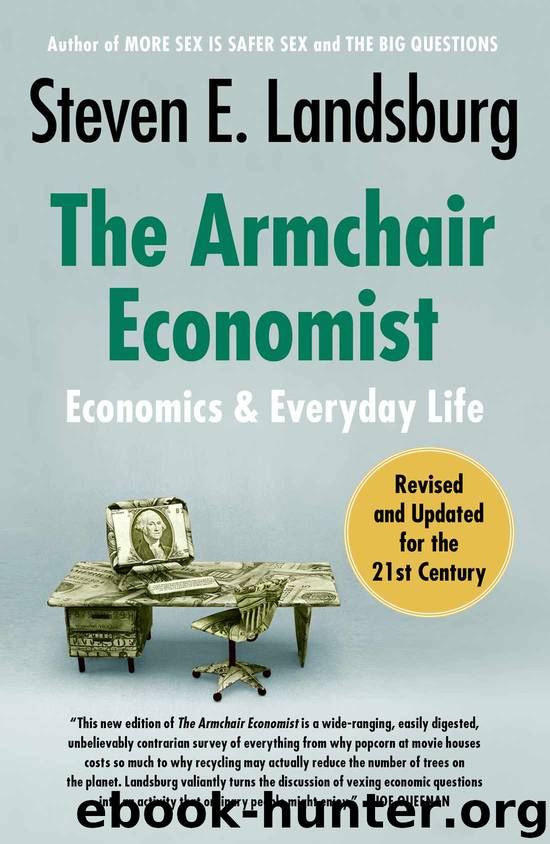
Author:Landsburg, Steven E. [Landsburg, Steven E.]
Language: eng
Format: epub, mobi
Publisher: Free Press
Published: 2007-11-01T00:00:00+00:00
Michael Kinsley, a journalist I much admire (and who hired me years ago to write for Slate magazine, for which I will be forever grateful), has a very persistent bee in his bonnet about capital gains, which he believes should be taxed at the same rate as wage income. The Kinsley argument, which he has repeated in countless (well, I at least have lost count) magazine and newspaper columns, runs like this:
(a) Economic theory tells us that everything should be taxed at the same rate.
(b) Q.E.D.
Step (a) is correct. Economic theory does tell us that we generally get better outcomes when everything is taxed at the same rate. If apples were taxed at 10 percent and oranges at 30 percent, some orange lovers would switch to eating apples just to save a buck. Better to tax both at 20 percent and encourage people to eat the fruits they prefer.
It’s in the transition from step (a) to step (b) that Kinsley loses his intellectual footing. He goes wrong because he misinterprets the word “everything.” The argument applies to apples and oranges, it applies to Coke and Pepsi, and it applies to red sneakers and blue sneakers. It also applies to apples consumed today and apples consumed tomorrow. If apples are taxed at 10 percent today and 30 percent tomorrow, some people will eat more apples today and fewer tomorrow just to save a buck. Better to tax all apples at 20 percent and encourage people to time their meals as they prefer.
But unlike apples and oranges or red sneakers and blue sneakers, “wage income” and “capital gains income” are not consumption goods that people choose between. Therefore the argument doesn’t apply to them.
But it’s worse than that. It turns out that if you take the Kinsley principle seriously—if, that is, you are determined to tax both current and future apples at the same rate—then you must be committed to taxing all capital income (including interest, dividends, and capital gains) at a rate of zero.
To understand why, it helps to have an imaginary friend.
My imaginary friend Alice earns $1 a day. Alice can use that dollar either to buy an apple or to invest in an interest-bearing account, wait for it to double, and then buy two apples.41
If we tax Alice’s wages at, say, 50 pecent, then her take-home pay falls to 50 cents a day. She can use that 50 cents either to buy half an apple or to invest in an interest-bearing account, wait for it to double, and then buy one apple. Either way, her buying power is cut in half. Instead of taxing her wages, we might as well have imposed a sales tax that doubles the price of apples, both now and in the future.
In other words, taxing Alice’s wages is just like taxing both her current and future apple purchases—and taxing both at the same rate.
Now along comes Michael Kinsley to complain that Alice pays no tax on her interest earnings. We therefore amend the tax code to include a 50 percent tax on interest.
Download
The Armchair Economist (revised and updated May 2012): Economics & Everyday Life by Landsburg Steven E.mobi
This site does not store any files on its server. We only index and link to content provided by other sites. Please contact the content providers to delete copyright contents if any and email us, we'll remove relevant links or contents immediately.
| Anthropology | Archaeology |
| Philosophy | Politics & Government |
| Social Sciences | Sociology |
| Women's Studies |
Born to Run: by Christopher McDougall(7132)
The Leavers by Lisa Ko(6950)
iGen by Jean M. Twenge(5419)
Sapiens by Yuval Noah Harari(5375)
Spare by Prince Harry The Duke of Sussex(5202)
The Kite Runner by Khaled Hosseini(5188)
Machine Learning at Scale with H2O by Gregory Keys | David Whiting(4317)
Bullshit Jobs by David Graeber(4197)
Never by Ken Follett(3963)
Goodbye Paradise(3813)
Livewired by David Eagleman(3778)
Fairy Tale by Stephen King(3403)
A Dictionary of Sociology by Unknown(3088)
Harry Potter 4 - Harry Potter and The Goblet of Fire by J.K.Rowling(3077)
The Social Psychology of Inequality by Unknown(3039)
Will by Will Smith(2930)
The Club by A.L. Brooks(2929)
0041152001443424520 .pdf by Unknown(2850)
People of the Earth: An Introduction to World Prehistory by Dr. Brian Fagan & Nadia Durrani(2740)
